
True wealth - for all nations
Celebrations of Adam Smith's great book from 250 years ago in Scotland across the year.

On 5th June 1723, a baby boy was baptised in Kirkcaldy – an ancient Royal Burgh in Fife. We remember Adam Smith’s baptism because that’s the closest we have to his date of birth. It would take until 9th March, 1776 for him to complete An Inquiry into the Nature and Cause of the Wealth of Nations, much of it written at his family home in the town. This year, complementing the splendid Smith 300 celebrations in 2023, which marked the anniversary of his birth, this year is full of events to mark his life, work and lasting influence.
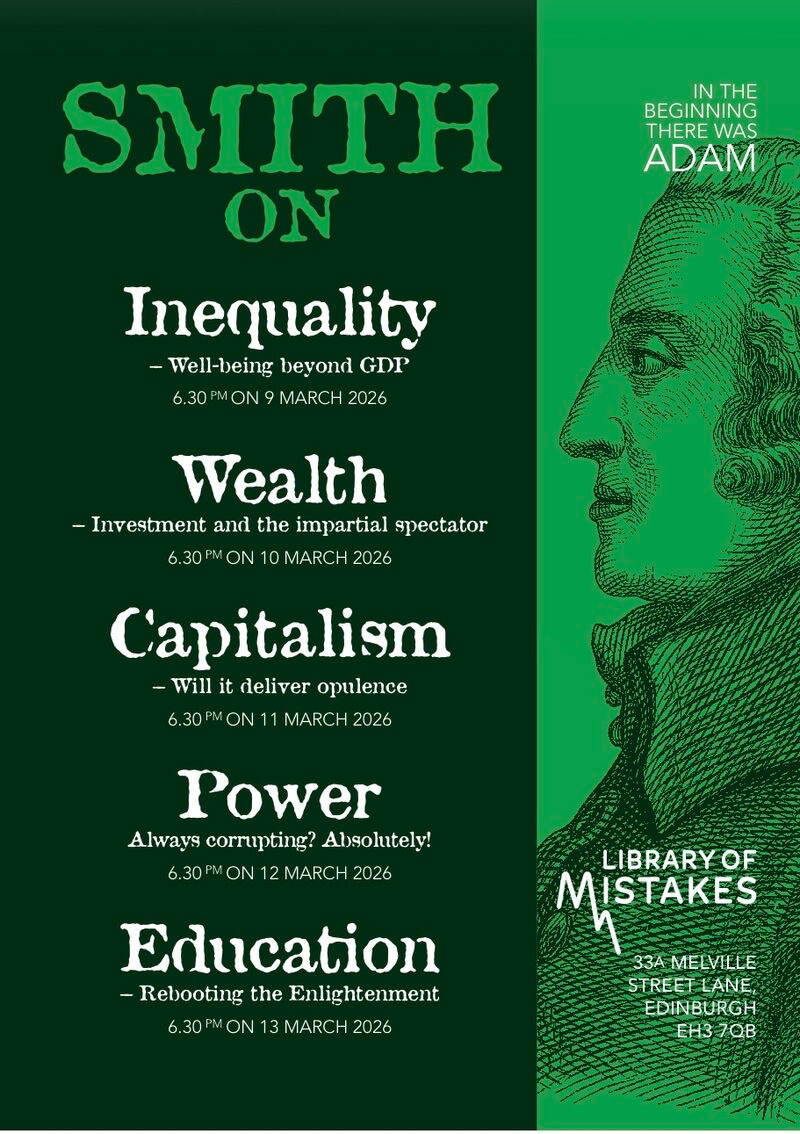
In Scotland, the Library of Mistakes started the ball rolling with the Smith Conversations in the week of 9th March. These engaging events covered inequality, wealth, capitalism, power and education – each conversation based on an idea important for Smith, but also today.
Adam Smith’s Panmure House, (Smith’s last home, now a research centre of Heriot-Watt University) also marked that week with a lecture from Baroness Dambisa Moyo on contemporary global economic challenges and a discussion on Adam Smith, Liberty and the future of the US-UK partnership – as part of the US Consulate General in Scotland’s contributions to the Freedom 250 celebrations.
In June, the pace of the celebrations will pick up. My plan is to be at as many of these events as possible, and carry on my habit of taking careful notes during the proceedings, writing them up soon after – effectively keeping a detailed diary. There is so much going on that you should expect several articles every week in June. Since I will be participating in some of these events, I will probably start posting soon to try out ideas as I draft them.
5th June:
The annual baptism celebration in Kirkcaldy will be an all day event, there will be a roundtable discussion on The Wealth of Nations, a masterclass on economic policy (involving two winners of the Nobel Memorial Prize in economics); and a discussion on the Future of the Economy moderated by leading journalists and involving senior academics, (former) political leaders and policy makers.9th – 10th June:
Adam Smith’s Panmure House will run a New Enlightenment conference at the Balmoral in Edinburgh. Consistent with Baroness Moyo’s lecture earlier this year, it will coverEconomic Dynamism and Abundance
Geoeconomic Competition and the New Wealth of Nations
Capitalism after ESG
AI and Human Flourishing
17th – 20th June:
The International Adam Smith Society will hold its conference at the University of Glasgow. Remembering that Adam Smith was a moral philosopher who wrote on political economy, so that his memory cannot adequately be guarded by mere economists, the Smith Society programme will include more than 100 presentations of academic papers from across the humanities and social sciences.18th June:
Ethical Finance Global – Retreat, Recalibrate or Revitalise. The Global Ethical Finance Initiative’s annual summit at the Sheraton Grand in Edinburgh will “examine whether recalibration represents a loss of ambition or a necessary evolution, and what genuine revitalisation looks like in practice”.
With the Summit anchoring the Edinburgh Finance Festival, as part of GEFI’s Radical Old Idea series, it will include the formal launch of a wide-ranging study of how best to apply Smith’s insights from the 18th century to the practice of asset management today.22nd June:
A workshop on The Legacy of Adam Smith, hosted by Les Oxley (University of Waikato) and Eoin McLaughlin (Heriot-Watt University) at the Library of Mistakes in Edinburgh, aiming at understanding better how Smith’s thinking has affected the development of economic ideas in the last 250 years.At other events, still being scheduled, the Library of Mistakes will pick up on some of the questions which there wasn’t time to consider in its Smith Conversations. Then, later in the year, there will be at least three important books from academics at Scottish universities:
Maha Rafa Atal: When Companies Rule: Corporate Power from the East India Company to Silicon Valley (Columbia University Press)
Eoin McLaughlin: The Inclusive Wealth of Nations, Bloomsbury Continuum
Alex Trew (editor): The Wealth of Nations at 250: Understanding Prosperity and Development in the Modern World, Cambridge University Press;
Alex and his collaborators have already trailed their work at the workshop Modern Inquiries into the Nature and Causes of the Wealth of Nations at Cambridge University on 5th – 6th March; and to be fully launched at the University of Glasgow conference Understanding Prosperity and Development in the Modern World on 8th – 9th October.
So, plenty of scholarship, as there should be, and even interest from asset managers. You’ll note that much of this activity is naturally aimed at specialists, some of whom have been studying Smith’s work for decades. Believing that the ideas in The Wealth of Nations are too important to be left to academics or professionals, when I post here, I will try to explain why I think that they should matter to everyone. And, most likely, I will present Smith as I will in my notes for the Global Ethical Finance Initiative: the right person at the right time to explain a rapidly changing world to his contemporaries, but with such profundity that his insights will be relevant for years to come.
Really looking forward to your June coverage, Robbie. The idea of Adam Smith explaining a rapidly changing world to his contemporaries with enough depth that it still matters 250 years later... that's a pretty incredible legacy. Would be wild to imagine. Wonder what he'd say.