
The future already determined
Karl Marx placing himself beyond the time in which he lived to explain all of history.

For the last couple of weeks, my mind has been on Adam Smith and celebrating the 250th anniversary of The Wealth of Nations. (This week, it’s also been on my mother’s 100th birthday.) Now back to my series of brief notes on leading economists.
In planning my book How to Think like an Economist, working out how to sketch the life of Karl Marx was challenging. Graham Garrard and James Bernard Murphy had already included him in the companion volume How to Think Politically, while Peter Cave had sketched his life in How to Think like a Philosopher.
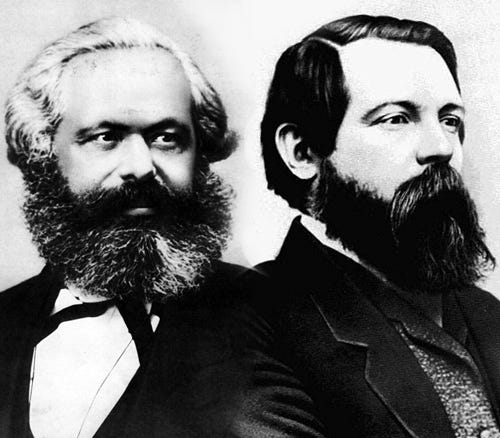
My problem wasn’t whether Marx was important enough for the book. Nor was it a lack of familiarity with his thinking about the economy because I’d ended up studying Marxian economics as an undergraduate. Rather, I feared that I would not be able say anything meaningful about his complex system of thought in a short chapter. Then, as I started to read, especially Robert Heilbroner’s last book Marxism: For and Against, I began to recognise just how much in Marx’s system was deeply familiar. In the 1840s, when Marx was a radical journalist, shuttling between cities in Northwest Europe to evade censorship and arrest, he started to treat David Ricardo’s Principles of Political Economy as the definitive statement of classical political economy. In an important sense, Marx represents the endpoint of the tradition of English political which flourished for a century after the publication of The Wealth of Nations.
With that realisation, I could set Marx against John Stuart Mill: the revolutionary socialist contrasted with the liberal reformer; the romantic idealist against the pragmatic utilitarian. That comparison might seem to favour Marx, and from that romantic idealism, he forged a system in which it was necessary to look at the world in a completely new way. Believing that the classical political economists had taken up a viewpoint which was too close to the activity which they were trying to understand, he pulled away from the present, attempting to construct a historicist account of the broad flow of human development. And in this, he was very like Adam Smith, but seeking to place the emergence of capitalism - rather than Smith’s commercial society - in a framework of historical inevitability. Where Smith then turned to policy analysis to conclude The Wealth of Nations, Marx speculated about the history of the future. Turning prophet, he predicted that the contradictions inherent in capitalism would lead to crises of increasing intensity with wealth accumulating in fewer and fewer hands until its eventual collapse in a communist revolution. Even more than when I was writing my essay, much in that account resonates today. And among economists, there is discomfort in responding to such clearly political arguments.
Taking the historicist method as explaining the Marx’s scope and approach, I concluded that it was essential to include in my brief sketch some account of his understanding of the alienation of labour, the emergence of capital as embodied labour (and so as work done, rather than as the potential to do work in future), the commoditisation of labour, so that the services which people contributed to processes of production became goods to be traded on markets, rather than remaining the property of workers, and the replacement of the circulation of money with a vast spiral of capital accumulation. In the classical political economy on which Marx built, there was very little about this, but in the understanding of capitalists’ desire for money being unbounded, I could see that Marx’s thinking had many parallels with the distinction between Aristotle’s virtuous oikonomia and its vicious counterpart, chrematistike. Unlike Adam Smith, then, Marx imagined a world in which people, shaped by the environment in which they find themselves, seem to grope, almost blindly, for gain. There is something of Tolstoy in the idea that people are shaped by their environment, responding to events with little awareness of the deeper currents which pull them first in one direction and then in another. That made political revolution in Marx’s thinking, rather than Smith’s reform of manners. And as a first step, workers needed to set aside the false consciousness through which they engaged with the world.
Having the structure for my essay, I still needed to give a flavour of how Marx, that massive brooding, discomfiting presence looming over all the social sciences and humanities made Adam Smith look hasty in sending his work to the printers. Dying in 1883, 30 years after he started work on "Das Kapital", he had only completed volume 1. The task of turning disjointed material into three publishable volumes fell to his devoted friend, frequent financial support, and punctilious editor, Friedrich Engels. Rich, worldly Engels, the sort of socialist whom Stalin would have quickly sent to the Gulags, devoted the last decade of his life to the task. After that, Kapital, written entirely in German, quickly gained adherents, providing a clear structure in which socialist theory could develop.
But for the purpose of my book, there was one final, critical difference between Mill and Marx. Where Mill continued to debate with other economists working in the classical tradition, towards the end of his life, he recognised some of its limitations, encouraging the work which would lead to its replacement. Marx worked entirely within his reimagining of the tradition of political economy, limiting the opportunities for fruitful discussion between his supporters and other economists. Marx’s vision had the its advantage over the new tradition in economics was in the analysis of dynamic change in the economy. This helps to explain that within the development of economic thinking late in the late 19th and early 20th centuries, it was the Austrian school, methodologically the closest to Marx, which established theories of the evolutionary development of the economy. The socialist revolutionary provoked the ideas which have today coalesced around libertarianism.