
146 died
A dreadful industrial accident - and the eventual political response

As so often, I find myself responding to Heather Cox Richardson. After her post this morning began in its usual way by setting out what she has gleaned in the last day about the activities of the Federal Government, including the activities of its President and his associates, she turned to an important anniversary.
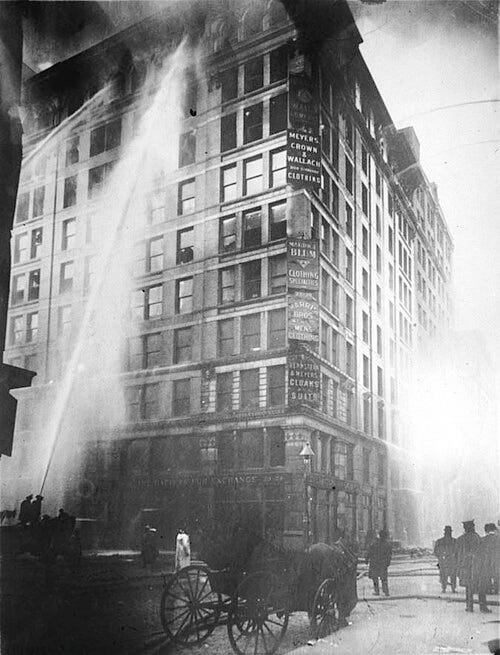
New York, on Saturday, 25th March 1911. The Triangle Shirtwaist Factory, located on the upper floors of a 12 storey building went on fire. Most of the doors in the factory were locked. Fleeing the conflagration, the manager left his keys in his office drawer, trapping hundreds of workers.
One hundred and forty six people, mostly women, died, many from smoke inhalation, but many fell to their deaths. (Probably not by jumping to their deaths - the force of the very hot air escaping the building would have been enough to push them off window ledges where they were trying to shelter.)
There were two very important witnesses to these horrific events. In nearby Washington Square, a young social worker, Frances Perkins, had been enjoying afternoon tea with friends. A lobbyist for the Consumer League, she was working at the State Legislature in Albany, garnering support for legislation to set a maximum 54 hour working week for women. Much more typical of the workers who had been trapped though, was the trade unionist, Rose Schneiderman.
Heather Cox Richardson concentrated on Frances Perkins’ memories of the event, easily accessible because of the hours of interviews which she gave in the 1950s as part of Columbia University’s Oral History Project. Her campaigning after the fire brought her to the attention of former President Theodore Roosevelt, who recommended her as the best possible secretary for the New York Committee on Safety. Established by citizens concerned about the conditions in the poorly designed and maintained factories across the state, the Committee was never part of the state government. Under Perkins’ direction it was extremely effective in securing the support of the state legislature. By the time that Governor Al Smith appointed Perkins to the board of the State Industrial Commission in 1919, the Committee’s proposals had become the basis of new, statutory safety codes. These New York standards were widely adopted, especially for new buildings, because they ensured safety through effective design.
In Perkins’ extensive recollections of this hugely productive period in her life, the name of Franklin Delano Roosevelt is largely absent. A member of the State Senate from 1911 - 1913, Perkins already knew him socially because of connections in New York. His habit of looking down his nose through his pince nez annoyed her, and she quickly pigeonholed him as a upper class lightweight, much more interested in conservation and agriculture than industrial safety.
Move on a decade. In that time, Roosevelt had left the New York legislature to become Assistant Secretary of the Navy in Woodrow Wilson’s administration and had fought a creditable, but losing, election campaign as the Democratic Party’s 1920 Vice Presidential candidate. By 1923, he was housebound, recovering slowly and painfully from the polio infection which had come close to killing him. Still determined to succeed in politics, he started to meet with his wife Eleanor’s political friends. Rose Schneiderman, who had risen from her fiery oratory at the time of the Triangle Shirtwaist Fire to be the President of the International Ladies Garment Workers’ Union was prominent among them. From Schneiderman, and others, Roosevelt acquired the political education which he needed to overcome his previous naivete about the state of industrial labour in the United States. [Perkins, though, harboured doubts about just what he understood, suspecting that he imagined a trade union to be essentially a modern version of a craft workers’ guild.]
We can think of the Triangle Shirtwaist fire as a turning point in American political history. In 1912, Theodore Roosevelt split from the Republican Party to become the Progressive Party’s candidate for the Presidency. In his Bull Moose campaign, rather than President Taft, who was seeking re-election, his principal opponent was the progressive Democrat, Woodrow Wilson. The election became a contest between Roosevelt’s New Nationalism, which promised a fair dealing for working class Americans through partnership with business. Wilson, drawing on the ideas of the immensely successful, but entirely progressive, commercial lawyer, Louis Brandeis, developed a New Freedom platform, in which business would face much greater scrutiny and regulation.
Wilson won, but his administration quickly became bogged down in managing American involvement with World War I. Then in 1918, the Democrats lost control of Congress. Conservative Republicans repeatedly won elections during the 1920s as the economy boomed. That meant that they were in power at the time of the Wall Street Crash in 1929 and the start of the Great Depression.
For Franklin Roosevelt, the Wilson Administration’s unfinished business was the starting point for his own mature politics, his sensibilities refined and radicalised by his wife’s friends. Sensing his moment of opportunity to reach the White House, he flew to the Democratic Party’s nominating convention in Chicago in July 1932, finishing his acceptance speech with the line, “I pledge myself - I pledge you - to a New Deal for the American people.” Other than a commitment to ‘endless experimentation’, he probably did not know what that New Deal would involve. But drawing in both Republican and Democrat progressives, it quickly built on the work started twenty years before to challenge the privileged wealth of America’s Gilded Age.